Fall 2026 Fine Art Catalog Is Here


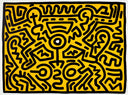
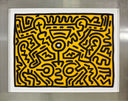


Growing #3, 1988
Price on Request
Details
Medium: hand-signed unique trial-proof screenprint
Year: 1988
Edition: 192
Sheet size: 30 x 40.12"
Image size: 30 x 40.12"
Framed size: 39 x 49.12"
Signature: signed and dated 'K. Haring 88' and annotated lower right vertical
Year: 1988
Edition: 192
Sheet size: 30 x 40.12"
Image size: 30 x 40.12"
Framed size: 39 x 49.12"
Signature: signed and dated 'K. Haring 88' and annotated lower right vertical
About the Work
"Growing #3" is a unique trial-proof screenprint created by Keith Haring in 1988 for his 'Growing' series. From the edition of 192, the unique trial-proof is signed and dated 'K. Haring 88' lower right. The artwork is framed in a custom, closed-corner, gold leaf frame and has a framed size of 39 x 49.12". The artwork ships framed and accompanied by a certificate of authenticity.
Dubbed “a child of Pop Art,” Keith Haring rose with remarkable speed in the 1980s to occupy a central position within the movement’s expanded field. His instantly recognizable line-work and saturated palette draw upon the visual language of mass media, yet his work resists mere appropriation. Instead, Haring forged a distinct pictorial system that merged accessibility with urgency, collapsing the boundaries between fine art, street culture, and social activism.
While much of Haring’s output engages weighty themes such as the AIDS crisis, apartheid, and systemic inequality, the 1988 "Growing" suite offers a luminous counterpoint. Here, the emphasis shifts toward vitality, rhythm, and collective joy. Across the series, bodies pulse and expand in a choreography that recalls the kinetic energy of 1980s dance culture, from breakdancing to vogue. Movement becomes both subject and structure, animating each composition with a sense of continuous transformation.
As Jeffrey Deitch observed, Haring’s work emerges directly from the body, a physical extension of the artist’s gesture and presence. This corporeal immediacy is central to "Growing." Figures stretch, multiply, and interlock, suggesting processes of evolution and interdependence. Circular forms function fluidly as heads, torsos, or generative seeds, reinforcing themes of origin and growth. In several compositions, a single figure proliferates outward like a branching organism, while in others, stacked bodies emphasize support, ascent, and communal becoming.
Formally and conceptually, "Growing" resonates with Haring’s "Pop Shop" series while advancing a more explicit meditation on transformation. The figures are stripped of hierarchy and identity, achieving an archetypal clarity that underscores Haring’s belief in shared humanity. This universality is not abstract but lived. Haring bridged disparate cultural spheres, from South Bronx hip hop to downtown club culture and conceptual art circles, synthesizing them into a unified visual language.
Equally significant is Haring’s embrace of printmaking as a democratic medium. By translating his drawings into screenprints, he enabled wide dissemination without sacrificing immediacy. Within this framework, experimentation remained vital, particularly in unique impressions that explore bold and subtle variations in color. These works blur the boundary between print and original, offering collectors both the cultural resonance of an iconic series and the rarity of singular expression.
Haring’s regular editions are desirable in their own right, as in "Growing #1," the most popular image in the series. However, three of these particular prints are unique trial-proof screenprints. "Growing #2,""Growing #3," and "Growing #5" feature experimental combinations of color — subtle variation in #3 and bold departure in #2. Unlike the regular edition prints, each trial proof is one of a kind, effectively blurring the line between printmaking and unique work. Collectors prize trial proofs for exactly this reason: they carry the aura of originality while also belonging to an iconic series.
Taken as a whole, the "Growing" suite encapsulates Haring’s enduring vision. It is a celebration of connection, movement, and shared existence, rendered with a clarity and optimism that continue to resonate.
About the Artist
Growing #3, 1988
Regular price
$285,000.00
SELECTED WORK
MORE FROM THIS ARTIST
Growing #3, 1988
Price on Request

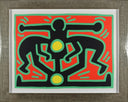
Growing #2, 1988
Price on Request
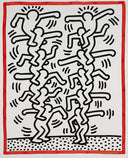

"People Ladder" (Three Lithographs), 1985
Price on Request


261 - Free South Africa (#2), 1985
Price on Request


Untitled (Pop Shop IV - D), 1989
Price on Request
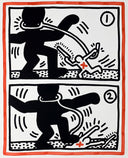
262 - Free South Africa (#3), 1985
Price on Request
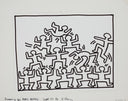
Drawings for Paris Review, 1982
Price on Request
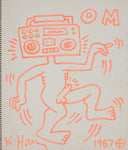
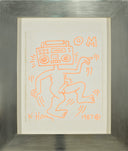
Untitled (orange drawing), 1987
Price on Request
Start your collection with guidance you can trust
For nearly 50 years, we’ve helped new collectors find artwork they love and understand the stories behind each piece. Our gallery consultants offer personalized guidance, whether you’re exploring originals, limited editions, or discovering an artist for the first time. Visit your nearest gallery to start collecting with confidence.

Frequently Asked Questions
Your artwork comes with a Certificate of Authenticity (or Letter of Authenticity), professional packaging, and insured delivery.
We ship fully insured, using trusted carriers. Each piece is professionally packed to ensure safe arrival. Shipping times vary based on the location of the art, its destination, and whether or not it is framed (ready to ship) at the time of your purchase.
All our works come beautifully framed. Some print multiples may have framing options if we have unframed editions available in our warehouse. Our in-house framing provides high-quality moulding, acid-free materials and either UV plexiglass or framer’s grade acrylic. High value works may be framed in custom, closed-corner frames, and are often framed in Optium museum glass for enhanced clarity.
No, Martin Lawrence Galleries does not provide appraisal services. To ensure that appraisals are fully independent and unbiased, it is best practice for them to be carried out by certified appraisers who have not had prior involvement with the sale or handling of the artwork. For that reason, we do not appraise artworks that we handle, and instead recommend that collectors seek an independent, certified appraiser.
No, we own the vast majority of our inventory and do not seek out consignments from Sellers.
Yes, if you purchase from a local gallery, your consultant will be happy to assist you with hanging the artwork in your home.
Martin Lawrence Galleries has seven galleries across the country where you may be able to see the exact piece you are interested in. Print and sculpture multiples are more likely to be in several places for possible viewings whereas unique artworks will be constrained to one location. We are happy to facilitate your visit to one of our galleries if that is convenient for you. We can also take videos and extensive photos if a visit is not possible. Please contact us at martinlawrencegalleries.com.
We have over 50 years of experience, seven gallery locations across the United States, and a track record of connecting collectors with the right artwork.
No. Our consultants are here to guide you through the process, answer your questions, and make buying art simple and rewarding.
We encourage you to buy what you love. Our consultants will help you find the right piece that fits your taste and collection.
Please visit our page on specific instructions on how to take care of your artworks. Care Instructions
We stand by our artwork. Please review our detailed return policy here.
OUR GALLERIES
Costa Mesa, California
3333 Bear Street
949-759-0134
Mon–Sat: 11:00am – 8:00pm
Sun: 11:00pm – 6:30pm
Las Vegas, Nevada
3500 Las Vegas Boulevard South
702-991–5990
Sun – Thurs: 10:00am – 11:00pm
Fri – Sat: 10:00am – 12:00am
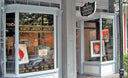
New Orleans, Louisiana
433 Royal Street
504-299-9055
Mon-Sun: 10am - 6pm
New York, New York
457 West Broadway
212-995-8865
Mon – Sat: 10:00am – 7:00pm
Sun: 11:00am – 7:00pm
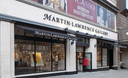
San Francisco, California
366 Geary Street
415-956-0345
Mon-Sun: 10am - 6pm
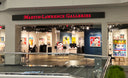
Schaumburg, Illinois
5 Woodfield Mall, Second Level Nordstrom Wing
630-954–3033
Mon – Sat: 10:00am – 9:00pm
Sun: 11:00am – 6:00pm