Fall 2026 Fine Art Catalog Is Here




Untitled (Dogs & Babies on Blue Background), 1980
Price on Request
Details
Medium: acrylic on plywood
Year: 1980
Sheet size: 30.5 x 27.25 x .75"
Image size: 30.5 x 27.25"
Framed size: 42 x 39"
Year: 1980
Sheet size: 30.5 x 27.25 x .75"
Image size: 30.5 x 27.25"
Framed size: 42 x 39"
About the Work
"Untitled (Dogs & Babies on Blue Background)" is an acrylic on plywood painting created by Keith Haring in 1980. The artwork is framed in a contemporary black stepped frame and has a framed size of 42 x 39".
Keith Haring’s "Untitled (Dogs & Babies on Blue Background)" is not just a painting with good provenance. It is a surviving piece of the world his art came from.
Painted on a plywood door from The Mudd Club, the legendary downtown New York venue where art, music, nightlife, fashion, performance, and social experiment all collided, the work carries a charge that a normal canvas could not. This was not made at a safe distance from culture. It was made on culture’s actual architecture — a door people passed, touched, opened, closed, leaned against, and moved around. Before it became an art object, it belonged to a living room of history.
That is what makes it feel so alive now. Much of today’s culture happens in temporary spaces or on disappearing platforms. Scenes flare up, get photographed, posted, branded, monetized, and erased almost instantly. The Mudd Club belonged to a different kind of cultural life: physical, improvised, unstable, communal, and real. This door is a fragment of that life. It is not nostalgia as decoration. It is evidence.
Across the blue ground, Haring repeats two of his most powerful symbols: the radiant baby and the dog. The babies carry the energy of new life, innocence, creative birth, and possibility. The dogs, in this work, do not feel like the aggressive barking dogs seen elsewhere in Haring’s language. They seem quieter, steadier, more protective. They hold the space around the babies. The alternation between them creates a rhythm of vulnerability and care, youth and protection, new energy and the forces that gather around it.
The composition feels almost like a crowd. The figures move in rows across the surface, repeating like bodies in a club, signals in a room, icons flashing through noise, music, and movement. Haring’s repetition is never merely decorative. It creates pulse. Here, the babies and dogs become a social rhythm, a little community of signs moving together across a door that once belonged to one of New York’s great gathering places.
The door itself deepens everything. A door is a threshold: between public and private, outside and inside, performance and backstage. In the context of The Mudd Club, that threshold becomes symbolic of downtown New York itself — a place where categories were constantly crossed. Artist and audience, gallery and nightclub, street and studio, serious and playful, high and low: all of it blurred.
In 2026, that matters. We live in a culture that talks endlessly about community while often experiencing it through screens. This work reminds us that culture is not only made by images. It is made by rooms, bodies, sound, risk, friendship, proximity, and shared energy. It comes from people being together in places that may not last.
The piece is humble in material but enormous in implication. A painted closet door becomes a record of a vanished scene. A grid of babies and dogs becomes a social pulse. What looks casual is actually vital: proof that art once lived directly inside the spaces where people gathered, danced, watched, protected one another, invented themselves, and disappeared into the night.
About the Artist
Untitled (Dogs & Babies on Blue Background), 1980
Regular price
$485,000.00
SELECTED WORK
MORE FROM THIS ARTIST
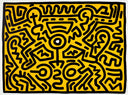
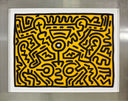
Growing #3, 1988
Price on Request
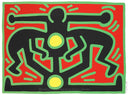
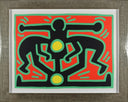
Growing #2, 1988
Price on Request
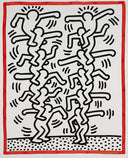

"People Ladder" (Three Lithographs), 1985
Price on Request


261 - Free South Africa (#2), 1985
Price on Request


Untitled (Pop Shop IV - D), 1989
Price on Request
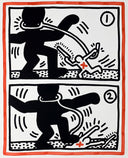
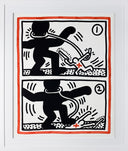
262 - Free South Africa (#3), 1985
Price on Request
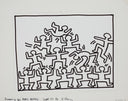
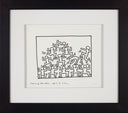
Drawings for Paris Review, 1982
Price on Request
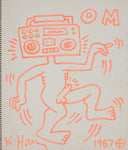
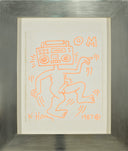
Untitled (orange drawing), 1987
Price on Request
Start your collection with guidance you can trust
For nearly 50 years, we’ve helped new collectors find artwork they love and understand the stories behind each piece. Our gallery consultants offer personalized guidance, whether you’re exploring originals, limited editions, or discovering an artist for the first time. Visit your nearest gallery to start collecting with confidence.

Frequently Asked Questions
Your artwork comes with a Certificate of Authenticity (or Letter of Authenticity), professional packaging, and insured delivery.
We ship fully insured, using trusted carriers. Each piece is professionally packed to ensure safe arrival. Shipping times vary based on the location of the art, its destination, and whether or not it is framed (ready to ship) at the time of your purchase.
All our works come beautifully framed. Some print multiples may have framing options if we have unframed editions available in our warehouse. Our in-house framing provides high-quality moulding, acid-free materials and either UV plexiglass or framer’s grade acrylic. High value works may be framed in custom, closed-corner frames, and are often framed in Optium museum glass for enhanced clarity.
No, Martin Lawrence Galleries does not provide appraisal services. To ensure that appraisals are fully independent and unbiased, it is best practice for them to be carried out by certified appraisers who have not had prior involvement with the sale or handling of the artwork. For that reason, we do not appraise artworks that we handle, and instead recommend that collectors seek an independent, certified appraiser.
No, we own the vast majority of our inventory and do not seek out consignments from Sellers.
Yes, if you purchase from a local gallery, your consultant will be happy to assist you with hanging the artwork in your home.
Martin Lawrence Galleries has seven galleries across the country where you may be able to see the exact piece you are interested in. Print and sculpture multiples are more likely to be in several places for possible viewings whereas unique artworks will be constrained to one location. We are happy to facilitate your visit to one of our galleries if that is convenient for you. We can also take videos and extensive photos if a visit is not possible. Please contact us at martinlawrencegalleries.com.
We have over 50 years of experience, seven gallery locations across the United States, and a track record of connecting collectors with the right artwork.
No. Our consultants are here to guide you through the process, answer your questions, and make buying art simple and rewarding.
We encourage you to buy what you love. Our consultants will help you find the right piece that fits your taste and collection.
Please visit our page on specific instructions on how to take care of your artworks. Care Instructions
We stand by our artwork. Please review our detailed return policy here.
OUR GALLERIES

Costa Mesa, California
3333 Bear Street
949-759-0134
Mon–Sat: 11:00am – 8:00pm
Sun: 11:00pm – 6:30pm

Las Vegas, Nevada
3500 Las Vegas Boulevard South
702-991–5990
Sun – Thurs: 10:00am – 11:00pm
Fri – Sat: 10:00am – 12:00am
New Orleans, Louisiana
433 Royal Street
504-299-9055
Mon-Sun: 10am - 6pm
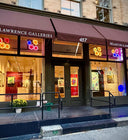
New York, New York
457 West Broadway
212-995-8865
Mon – Sat: 10:00am – 7:00pm
Sun: 11:00am – 7:00pm
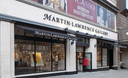
San Francisco, California
366 Geary Street
415-956-0345
Mon-Sun: 10am - 6pm
Schaumburg, Illinois
5 Woodfield Mall, Second Level Nordstrom Wing
630-954–3033
Mon – Sat: 10:00am – 9:00pm
Sun: 11:00am – 6:00pm