Fall 2026 Fine Art Catalog Is Here


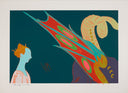



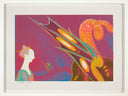
St. George and the Dragon (FS.II.327, Details of Renaissance Paintings), 1984
Price on Request
Details
Medium: hand-signed screenprint
Year: 1984
Edition: 107
Sheet size: 32 x 44"
Image size: 25 x 37.12"
Framed size: 36 x 46.75"
Signature: signed 'Andy Warhol' and annotated lower left
Year: 1984
Edition: 107
Sheet size: 32 x 44"
Image size: 25 x 37.12"
Framed size: 36 x 46.75"
Signature: signed 'Andy Warhol' and annotated lower left
About the Work
"St. George and the Dragon (FS.II.327)" is a screenprint created by Andy Warhol in 1984 for his series 'Details of Renaissance Paintings'. From the edition of 107, the artwork is signed 'Andy Warhol' and annotated lower left. The artwork is framed in a contemporary white frame and has a framed size of 36 x 46.75". The artwork ships framed and accompanied by a certificate of authenticity.
Andy Warhol’s "St. George and the Dragon (FS.II.324–327)," from the 1984 "Details of Renaissance Paintings" series, transforms Paolo Uccello’s Renaissance image into a bold meditation on myth, repetition, and visual power. Rather than reproducing the full narrative, Warhol isolates a fragment: the princess at left, facing the dragon, while St. George himself is effectively cropped out. This choice shifts the emphasis away from heroic action and toward a more ambiguous encounter between vulnerability, danger, beauty, and spectacle.
The source story is familiar: St. George rescues a princess by defeating a dragon, a medieval image of courage, faith, and good overcoming evil. Warhol’s version complicates that clarity. By removing the heroic center of the scene, he leaves the viewer with the princess and the beast, transforming the image into something stranger and more psychologically charged. The dragon, with its spiked wings, horned head, and curling tail, becomes the dominant visual force. It is less an adversary to be slain than a graphic apparition, almost comic-book-like in its sharp contours and theatrical menace.
Jane Daggett Dillenberger perceptively compared Warhol’s treatment to a comic strip, suggesting that the feats once associated with saints and legends may now be found in the modern mythology of superheroes. That observation is especially apt here. Warhol does not mock the Renaissance source; he translates it into a contemporary language of flat color, high contrast, cropping, and serial variation. The sacred and legendary become newly immediate, closer to mass media, fantasy, and Pop spectacle.
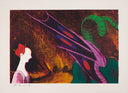
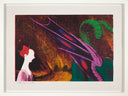
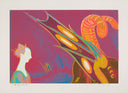
Across the four prints, color becomes the major vehicle of interpretation. The black-ground version, with its acid green dragon, feels the most ominous and nocturnal; the princess appears stark and isolated against the threatening form. The hot pink and orange version is the most electric, turning the scene into a vivid Pop confrontation. The darker red and green impression feels denser and more atmospheric, almost infernal, with the dragon emerging from a turbulent field of color. The deep blue version, with red wings, turquoise lines, and yellow accents, is the cleanest and most graphic, giving the image a contemporary, design-forward clarity.
Together, the four works demonstrate Warhol’s ability to alter mood without changing the underlying composition. The same myth becomes dark, playful, fiery, or sleek depending on color alone. This serial approach connects the prints to Warhol’s broader interest in how images survive through repetition and variation.
"St. George and the Dragon" is not a straightforward devotional or heroic image. It is Warhol’s Renaissance remix: a fragment of an old legend made strange again, where the absence of the hero allows the image itself — princess, dragon, color, and myth — to take center stage.
About the Artist
St. George and the Dragon (FS.II.327, Details of Renaissance Paintings), 1984
Regular price
$98,850.00
SELECTED WORK
MORE FROM THIS ARTIST


Sidewalk (FS.II.304, Eight by Eight), 1983
Price on Request


Kiku (FS.II.308), 1983
Price on Request
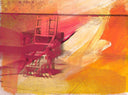
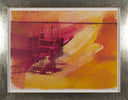
213 - Electric Chair (FS.II.81), 1971
Price on Request


Blackglama (FS.II.351, Ads), 1985
Price on Request


After the Party (FS.II.183), 1979
Price on Request
Start your collection with guidance you can trust
For nearly 50 years, we’ve helped new collectors find artwork they love and understand the stories behind each piece. Our gallery consultants offer personalized guidance, whether you’re exploring originals, limited editions, or discovering an artist for the first time. Visit your nearest gallery to start collecting with confidence.

Frequently Asked Questions
Your artwork comes with a Certificate of Authenticity (or Letter of Authenticity), professional packaging, and insured delivery.
We ship fully insured, using trusted carriers. Each piece is professionally packed to ensure safe arrival. Shipping times vary based on the location of the art, its destination, and whether or not it is framed (ready to ship) at the time of your purchase.
All our works come beautifully framed. Some print multiples may have framing options if we have unframed editions available in our warehouse. Our in-house framing provides high-quality moulding, acid-free materials and either UV plexiglass or framer’s grade acrylic. High value works may be framed in custom, closed-corner frames, and are often framed in Optium museum glass for enhanced clarity.
No, Martin Lawrence Galleries does not provide appraisal services. To ensure that appraisals are fully independent and unbiased, it is best practice for them to be carried out by certified appraisers who have not had prior involvement with the sale or handling of the artwork. For that reason, we do not appraise artworks that we handle, and instead recommend that collectors seek an independent, certified appraiser.
No, we own the vast majority of our inventory and do not seek out consignments from Sellers.
Yes, if you purchase from a local gallery, your consultant will be happy to assist you with hanging the artwork in your home.
Martin Lawrence Galleries has seven galleries across the country where you may be able to see the exact piece you are interested in. Print and sculpture multiples are more likely to be in several places for possible viewings whereas unique artworks will be constrained to one location. We are happy to facilitate your visit to one of our galleries if that is convenient for you. We can also take videos and extensive photos if a visit is not possible. Please contact us at martinlawrencegalleries.com.
We have over 50 years of experience, seven gallery locations across the United States, and a track record of connecting collectors with the right artwork.
No. Our consultants are here to guide you through the process, answer your questions, and make buying art simple and rewarding.
We encourage you to buy what you love. Our consultants will help you find the right piece that fits your taste and collection.
Please visit our page on specific instructions on how to take care of your artworks. Care Instructions
We stand by our artwork. Please review our detailed return policy here.
OUR GALLERIES

Costa Mesa, California
3333 Bear Street
949-759-0134
Mon–Sat: 11:00am – 8:00pm
Sun: 11:00pm – 6:30pm
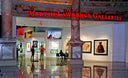
Las Vegas, Nevada
3500 Las Vegas Boulevard South
702-991–5990
Sun – Thurs: 10:00am – 11:00pm
Fri – Sat: 10:00am – 12:00am
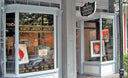
New Orleans, Louisiana
433 Royal Street
504-299-9055
Mon-Sun: 10am - 6pm
New York, New York
457 West Broadway
212-995-8865
Mon – Sat: 10:00am – 7:00pm
Sun: 11:00am – 7:00pm
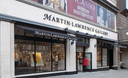
San Francisco, California
366 Geary Street
415-956-0345
Mon-Sun: 10am - 6pm
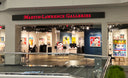
Schaumburg, Illinois
5 Woodfield Mall, Second Level Nordstrom Wing
630-954–3033
Mon – Sat: 10:00am – 9:00pm
Sun: 11:00am – 6:00pm